Amazon reader promise Bring your copy when we meet at a designated in-person session: Dr. Chiang will personally sign it and take a photograph with you. Read the promise
Below the line: a record you can open
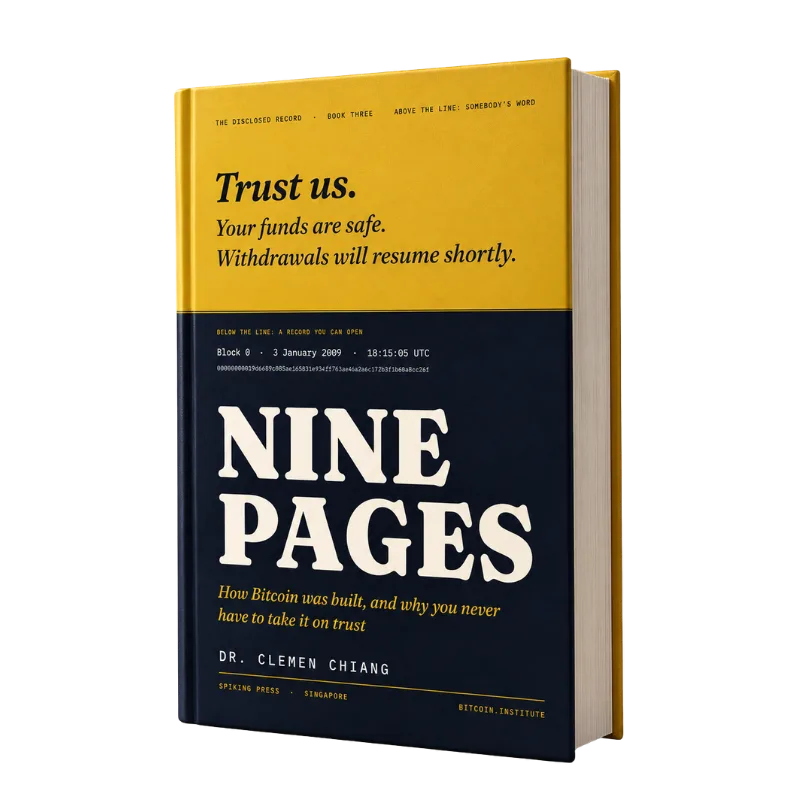
Block 0 · 3 January 2009 · 18:15:05 UTC000000000019d6689c085ae165831e934ff763ae46a2a6c172b3f1b60a8ce26f
Nine Pages
How Bitcoin was built, and why you never have to take it on trust
Thirty-four chapters. Five parts. One hundred and two dated entries at the back, each with the block, the transaction, the docket or the filing that proves it. No price targets, no forecasts, no allocation — and a reader who can check every claim without asking anyone's permission.
102 handles you can open50,000+ students taughtSince 2003 teaching marketsYour copy, personally signed
Since block 0
—
Elapsed since 18:15:05 UTC, 3 January 2009, computed from your device's clock. The chain has produced a block roughly every ten minutes through all of it; the exact count is a chain reading your own node confirms.
4Appendices · the whitepaper, verification, custody, a first purchase
0Price targets, forecasts or allocations
The Disclosed Record · Book Three · BitcoinAbove the line: somebody's word
Trust us.Your funds are safe. Withdrawals will resume shortly.
The trust line
One book · three next moves
Buy it. Check it. Then argue with the author.
The book is the beginning of the relationship, not the end of the transaction. Every path below stands on its own: buying does not require a masterclass, a review unlocks nothing, and the autograph promise does not depend on a rating.
01
Own the complete book
Hardcover, paperback or Kindle, direct from Amazon. The product page is the single source for current format, price, delivery and availability.
Every dated entry carries the primitive record that proves it. The chain handles take about ninety seconds each from a laptop; Appendix B shows how, and the maintained Record on this site keeps them current.
Join a masterclass taught by Dr. Chiang. At designated in-person sessions, bring your Amazon copy for a personalised autograph and a photograph together.
“If you bought Nine Pages on Amazon and bring your copy when we meet at a designated in-person masterclass or signing session, I will personally autograph it, personalise it to you, and take a photograph with you. That is my promise.”
Dr. Clemen Chiang CEO, Aly Pte. Ltd. · Author of The Disclosed Record
A promise to readers, not a review incentive. The autograph and photograph do not depend on a review, a star rating or what a review says. They apply when Dr. Chiang and the reader are physically present at a designated session, subject to the published event arrangements and capacity. Travel and admission are not included. Online registration is not a physical signing appointment.
Authority without borrowed hype
The proof is not praise. It is a handle.
There are no returns, no holdings and no screenshots in the book. Where the author says a thing happened, he names the record that proves it — a block height, a transaction, a court docket, a filing — of a kind the reader can pull without asking anyone's permission. Where the record is thin, the book says so in print.
One hundred and two dated entries
From the thirty-first of October 2008 to the cut-off date of 27 September 2026, in a Record that closes at one hundred and two because padding to a round number is the failure the section exists to prevent.
Seven residual notes
Where a handle was opened and the record beneath it proved thinner than the entry needs, a line beneath the handle says what is missing. One of them says a figure cannot be closed by anyone, and why.
No provider named
No exchange, custodian, broker, hardware maker, issuer or fund is named for the reader to use, paid for inclusion, or given approval over the text. Appendix D sets out a first purchase mechanically, naming nobody.
How it came to exist. What it survived. What transfers.
Five parts, in the manuscript's order. Part Two has no history, no personalities and no price; it is the part you will want to skip and the part that decides whether the rest is worth anything.
Six chapters, and every one of them is about something that happened before anybody was arguing.
What money is, and the answer most of us were never taught: a record before an object. The people who spent a quarter of a century trying to build a record nobody keeps. Nine pages. A block. Two pizzas. The day the author stopped writing.
1Money Is a Ledger
2The Ancestors
3Nine Pages
4The Genesis Block
5Two Pizzas
6The Author Leaves
Almost every bad argument about Bitcoin is a mechanical error wearing a philosophical costume.
What a transaction is. How a block is made. Where the twenty-one million comes from and why it is smaller than it looks. What difficulty is, what hashrate is not, what a key actually is — then one chapter that asks you to stop reading and go and look.
7There Is No Coin
8Proof of Work in Plain Arithmetic
9Twenty-One Million
10Difficulty, Hashrate and the Ten Minutes
11Keys
12Read the Chain
Seven chapters, and in almost every one the thing that failed was not the system.
An exchange in Tokyo. A two-year war over one number. A fork that proved what a fork proves. A marketplace, a Thursday in March, a government that could ban half the world's mining and did, and a year in which the middlemen failed one after another.
13Mt. Gox
14The Block Size War
15What a Fork Proves
16Silk Road
17Twelve March 2020
18The Hashrate Migration
19The Year the Middlemen Failed
Nine chapters, beginning with the author's own reversal and ending with a bridge.
A listed company decides its cash is the risky asset. A small country makes the thing compulsory and then stops. A regulator refuses for a decade and a court tells it why it cannot. Eleven products in one morning, an accounting of the electricity, and what is settled and what is not at the cut-off date.
20The Twelfth of May
21The Corporate Treasury
22Legal Tender
23Custody, Futures, and a Decade of Refusals
24Ten January 2024
25What the Chain Is For
26The Energy Accounting
27What Is Settled, What Is Not
28The Bridge
Nothing in this part tells you what to buy. It tells you what the record shows, and where the record stops.
A jurisdiction that regulated the activity rather than the asset. Why C runs alongside the other three letters rather than after them. What a reader of the first two books already knows that is worth more here than they think — and what will hurt them. A site, a proposal, and a clock.
Each entry in the book has four parts: the date the thing happened, a title, two to four sentences, and the handle that proves it. These are three of the one hundred and two, printed as they appear. Copy the handle and open it in any public block explorer, court record system or filing index — or your own node.
2 · 3 January 2009
Block Zero
The first block was mined with a coinbase carrying that morning's newspaper headline. The subsidy of fifty coins in it cannot be spent; the output was never added to the set of spendable coins.
Handleblock 0 · 18:15:05 UTC · 000000000019d6689c085ae165831e934ff763ae46a2a6c172b3f1b60a8ce26f
42 · 11 May 2020
The Third Halving
At block 630,000 the subsidy fell from 12.5 to 6.25 coins, on schedule and without anyone's decision. The next day the author took his position, in public, after eleven years of saying no.
Handleblock 630000 · 19:23 UTC · compare the coinbase at 629,999 and subtract the fees
102 · 23 September 2026
The Record Closes
BitMEX, the venue that invented the perpetual, closed after eleven years in the same year the instrument was approved onshore. The Record was laid out for a hundred entries and closes at one hundred and two: that is where the events stopped.
Handleoperator notice of 23 July 2026 · closure 04:00 UTC, 23 September 2026 · Dated Record, entries 96–102
The maintained Record — all one hundred and two entries, with corrections dated and errors preserved rather than deleted — is kept on this site, which carries no advertising and no product.
Look inside
Start with the ledger. Read the chain. Then decide.
The sample is ungated, because a book that asks to be checked should let the reader inspect its argument before asking for trust. Forty pages: the front matter, complete Chapter 1, and complete Chapter 12 — the afternoon on a laptop that verifies the supply.
Chapter 1 · page 3Money Is a LedgerChapter 12 · page 95Read the ChainChapter 20 · page 163The Twelfth of May
Eleven years of saying no, reversed in public and on the record.
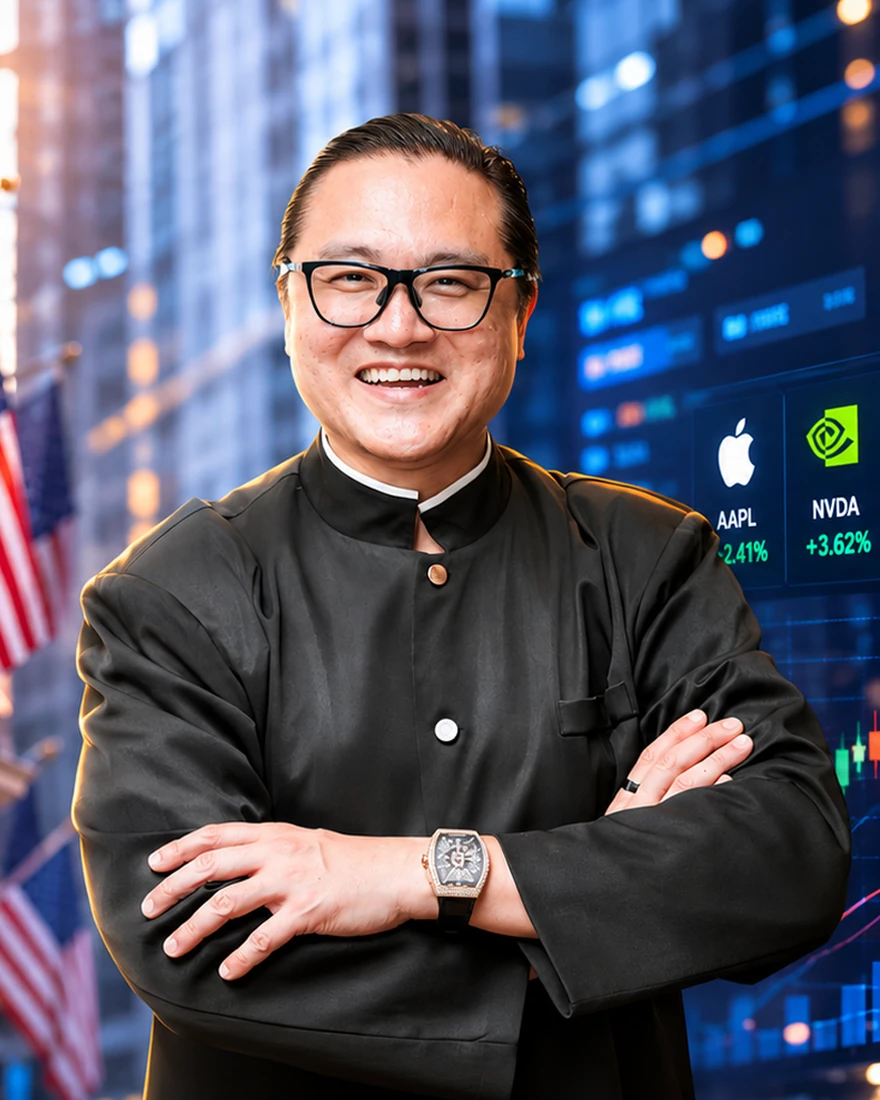
Dr. Clemen Chiang read civil and structural engineering at Nanyang Technological University, wrote to the Cboe Options Institute in his final year, and began teaching options in 2003 — among the first in Asia to do so. He has taught more than fifty thousand students, founded Spiking in 2016, and is a portfolio manager at Lucerne Asset Management.
He first wrote about this market in Spiking To The Moon, a beginner's guide to whales. Nine Pages supersedes it. On the twelfth of May 2020, the day after the third halving, he reversed eleven years of public scepticism about Bitcoin, live and timestamped, in front of several hundred of his own students; Chapter 20 is an account of what preceded that and what it cost.
2000Correspondence with the Options Institute at Cboe begins
2003Begins teaching options
2016Founds Spiking, named Best Innovative Start-up at the SiTF Awards
2020The twelfth of May: the position is taken, in public, and stays on the record
2026The Disclosed Record: The Wall Came Down, Long Island, Nine Pages
There is no praise on the cover. The next reader should hear from you.
Praise is somebody's word about a book. Read enough to form your own view, say what became clearer, what you disagreed with, and who would — or would not — find the book useful. No incentive, no request for a positive review. The autograph, photograph and masterclass paths do not depend on a review, a rating or what a review says.
Build the notes for your honest Amazon review
These notes stay in your browser. Nothing is submitted to bitcoin.institute or to Amazon.
Money is a record of obligation before it is an object, and the object is a portable summary of the record.
The instrument was never the problem the regulators were solving for, and the venue was never the thing that made it dangerous.
The first group experienced a market. The second experienced an insolvency.
The book before this one was about property, and it is already on the shelf. The one after it is about equities, and it is not yet written.
The book explains. The room lets you argue back.
Learn the material from the author who wrote it.
The public masterclass works from the record: what a block is, what a key is, what custody actually means, and what the two books before this one already taught that transfers here — and what does not. The same material, worked through live, for people who learn faster when they can put a question into the room.
Author-led, liveDr. Chiang teaches the session himself.
No background requiredStarts with what money is; no exchange account, no wallet, nothing to buy.
Evidence before opinionEvery claim in the session points at a handle you can open afterwards.
Your questions, in the roomLive attendance preserves the Q&A. Replay is complimentary if you bought a copy of the book.
Buy on AmazonScan to open the official product page.Learn with the authorScan for the current date, format and registration.
Registration open
Choose your live session.
Format
Live online · replay for readers who bought the book
Registration
Complimentary
In person
Designated sessions announced on the registration page
Online learning and in-person signing are separate. Bring your Amazon copy to an announced in-person session for your personalised autograph and photograph.
Straight answers
Before you buy — or register.
Where can I buy Nine Pages?
Use the Amazon link on this page. Amazon shows the current format, price, delivery estimate and availability for your location. The Kindle edition delivers on 13 October 2026; hardcover and paperback follow on the same page.
What is Dr. Chiang's autograph and photograph promise?
Bring your physical Amazon-purchased copy to a designated in-person masterclass or signing session where Dr. Chiang is present. Subject to the published event arrangements and capacity, he will personalise and autograph your copy and take a photograph with you.
Do I need to leave a review?
No. Reviews, ratings and review content have no connection to the autograph, the photograph or the masterclass. No benefit is offered in exchange for a review.
Does the book tell me what to buy, or what Bitcoin will be worth?
No. It contains no price target, no forecast, no allocation guidance and no statement of return — and no returns of the author's own. It sets out what the record shows, how the thing was built, what it survived, and what is still unsettled at the cut-off date of 27 September 2026.
Does it recommend an exchange, a wallet or a custodian?
No provider is named anywhere in the book, and none was paid for inclusion or given approval over the text. Appendix D sets out a first purchase mechanically — the order of operations, the costs and the errors that cannot be undone — naming nobody.
Where should I start?
If you are impatient, Chapter 12: it asks you to verify one thing yourself, and takes an afternoon. Otherwise read it in order; Part Two is the mechanics the rest of the book is an argument about.
What is bitcoin.institute?
The maintained version of the book's Dated Record, its errata log and the companion to Appendix D, on a domain the author owns that carries no advertising and no product. Chapter 32 explains the arrangement and where its weaknesses are.
Is this investment advice?
No. The book, this site and the masterclass are for general education. Bitcoin is volatile, has fallen by more than three-quarters from its high on four occasions, and its transactions cannot be reversed. Obtain independent professional advice before committing to any asset.
Below the line
Read the record. Meet the author.
Own Nine Pages on Amazon. Learn the material live with Dr. Clemen Chiang. And when we meet at a designated in-person session, bring your copy for the promise written into this page.