From Appendix B · How to verify every claim in this book
Open a handle yourself.
Every claim in the book carries a handle. This page tells you what to do with each kind, without asking anyone's permission and without naming anybody to trust.
One caution first. The book says in several places that something is checkable in about ninety seconds, and where it says so it is talking about a chain handle: a block height, a transaction, a subsidy. Those really are that fast. A court filing or an agency release is not. Finding a docket, paying for a document and reading it takes longer, sometimes much longer, and the reading is the part that matters.
The four kinds of handle
| Handle looks like | It is | Where to check it |
|---|---|---|
| Block 630000 | A block height | Any public explorer, or your own node |
| A 64-character hexadecimal string | A transaction identifier | Any public explorer, or your own node |
| A court name and case number | A filing | Public court record systems and free mirrors of them |
| An agency release, statute or regulation number | An official document | The agency's own site or the official gazette |
Anything else, such as a company statement, a press report or a survey, is flagged in the entry itself as not being a primitive record. Those are the weakest links in the book and they are labelled so you can weigh them accordingly.
Verifying a block
Enter the height into an explorer. You will see its timestamp, its size, its transaction count, its hash, the hash of the block before it, and its coinbase transaction: the first transaction, which pays the producer. Three things are worth doing at least once.
- Decode a coinbase.For block zero, take the coinbase input's hexadecimal data and convert it to text. The newspaper line appears. Most explorers show this decoded already; do it yourself once anyway.
- Compare subsidies across a halving.Look at the coinbase output value in block 210,000 and in 209,999. Subtract each block's total fees first, because the coinbase pays the subsidy plus the fees of every transaction in the block, so the raw figures will not be an exact half. What remains is 50 on one side and 25 on the other. Repeat at 420,000, 630,000 and 840,000; at the last of these the fees were larger than the subsidy, so the raw comparison is not merely imprecise but actively misleading. This is the entire supply argument, established from primary evidence in a few minutes.
- Count confirmations.Note the height of a block containing a transaction you care about, and subtract it from the current height. That number is how much work would have to be redone to reverse it.
# from your own node: block zero, then the third halving and the block before it
bitcoin-cli getblock $(bitcoin-cli getblockhash 0)
bitcoin-cli getblockstats 630000
bitcoin-cli getblockstats 629999
Verifying a transaction. Enter the identifier. You will see the inputs consumed, the outputs created, and the block that contains it. Sum the inputs, sum the outputs; the difference is the fee.
- 2Block Zero3 January 2009 · Bitcoin genesis block mined
- 4The First Transaction12 January 2009 · First Bitcoin transaction, Satoshi Nakamoto to Hal Finney
- 7Ten Thousand Coins, Two Pizzas22 May 2010 · Bitcoin Pizza Day, Laszlo Hanyecz pays 10,000 bitcoin
- 9The Value Overflow15 August 2010 · Bitcoin value overflow incident, 184 billion coins
Verifying a court filing
Federal American filings are available through the official electronic records system, which charges small fees, and through free mirrors that hold most documents of public interest. Search by case number or party name. Read the document rather than the coverage of it; the two differ more often than you would expect.
- 11Silk Road Opens6 February 2011 · Silk Road marketplace opens
- 22A Court Calls It Money6 August 2013 · SEC v. Shavers, a court holds Bitcoin investments are investments of money
- 23The Marketplace Is Seized2 October 2013 · Silk Road seized and Ross Ulbricht arrested
- 28Eight Hundred and Fifty Thousand28 February 2014 · Mt. Gox enters civil rehabilitation, 850,000 bitcoin missing
Verifying an official document
Securities filings are in the regulator's public database, searchable by company. Executive orders, agency rules and proposals are in the federal gazette. Legislation and its procedural history, meaning committee action, calendar placement and votes, are on the legislature's own site. European regulations are in the official journal. Singapore's legislation and the regulator's notices are on the government's statutes site and the regulator's own.
- 19Cyprus16 March 2013 · Cyprus bank deposit levy
- 20FinCEN Speaks18 March 2013 · FinCEN virtual currency guidance FIN-2013-G001
- 25The Senate Hearing18 November 2013 · First United States Senate hearing on virtual currencies
- 26Beijing Draws a Line5 December 2013 · China's 2013 notice on preventing Bitcoin risks
Protocol documents, releases and archived posts
Improvement proposals and release notes sit in the project's public repositories, found by number or by tag. Mailing list and forum posts sit in their public archives, found by author and date. Read the text itself, at the tag or the date the handle names.
- 1The Paper Is Posted31 October 2008 · Bitcoin whitepaper posted by Satoshi Nakamoto
- 3Version 0.19 January 2009 · Bitcoin version 0.1 released
- 10The Last Forum Post12 December 2010 · Satoshi Nakamoto's last forum post
- 16Pay to Script Hash1 April 2012 · Pay to Script Hash (BIP 16) activates
Where there is no primitive record
Some entries rest on a company statement, a press report or exchange trade data. The handle says so in those words, for example "exchange records, not chain records". Look for the statement or the archived page the handle names, and treat it as what it is.
- 5A Price Is Published5 October 2009 · First published Bitcoin exchange rate, New Liberty Standard
- 6The First Documented Sale for National Currency12 October 2009 · First documented sale of Bitcoin for dollars, Martti Malmi
- 8Mt. Gox Opens17 July 2010 · Mt. Gox exchange launched by Jed McCaleb
- 12One Dollar9 February 2011 · Bitcoin reaches one dollar on Mt. Gox
Running your own node
Download the reference implementation from its project site, verify the download's signature, and let it validate the chain from block zero. Allow several days and a few hundred gigabytes; pruning options reduce storage substantially at the cost of not retaining full history.
What this gives you is not convenience. Explorers are more convenient. It is that your machine has checked every rule for itself since 2009 and will reject an invalid block regardless of who produced it or how much work stands behind it. Chapter 12 of the book asks you to verify one thing yourself. It takes an afternoon and changes how every chapter after it reads.
If a handle does not check out
Report it. Give the entry or chapter, the handle as printed, and what you found instead. Corrections are published with their date and substance, the original error is not deleted, and you are credited by name if you ask to be, and not otherwise. How to report.
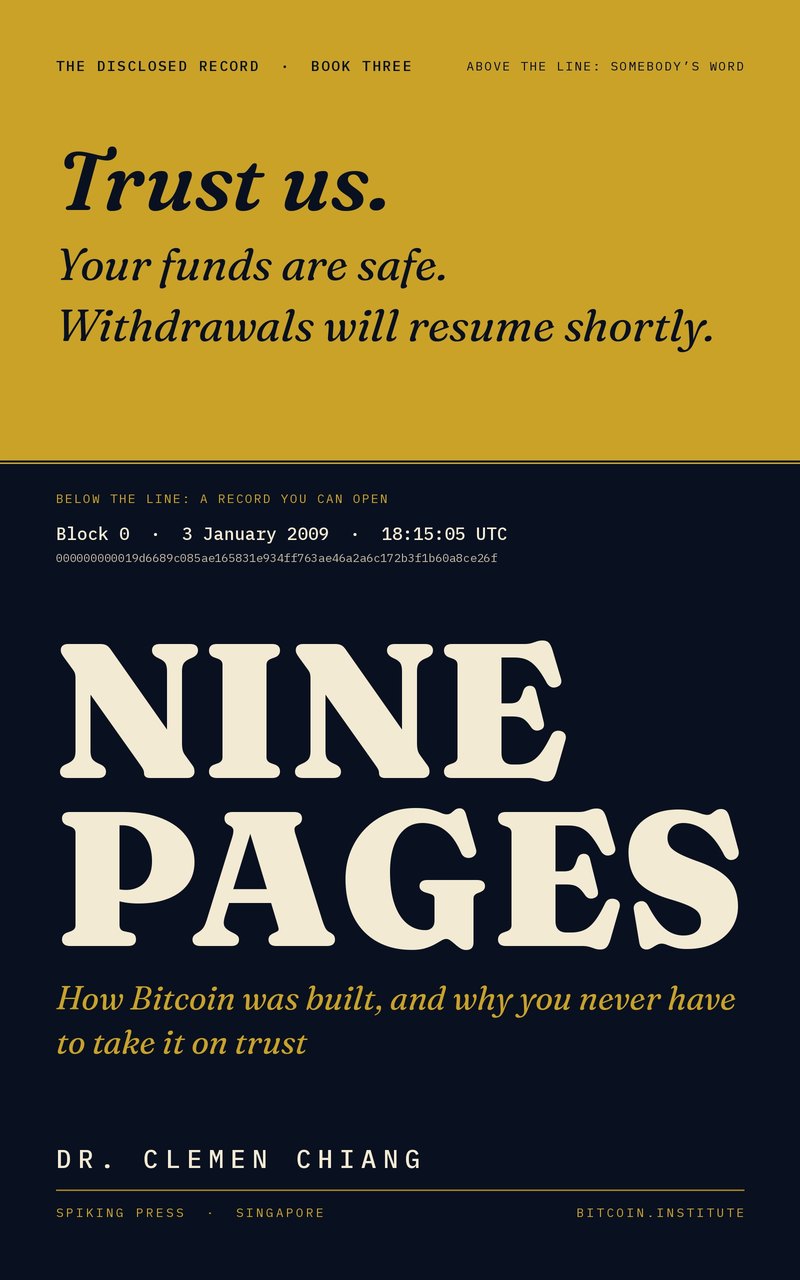
Nine Pages
How Bitcoin was built, and why you never have to take it on trust. The free sample includes Chapter 12, Read the Chain, the chapter that asks you to verify one thing yourself before you believe anything else in the book.
- 34 chapters in five parts
- 102 dated entries, each with its handle
- No price targets, forecasts or allocation
- Hardcover · Paperback · Kindle · Audiobook